A Digital Museum: Preserving the Golden Era of Gadgets with a Nostalgic Graphics Collection
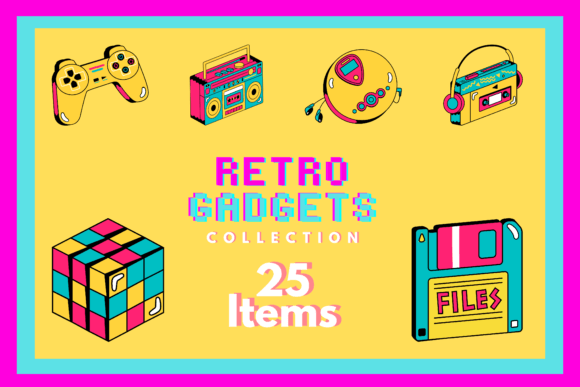
We live in a world of relentless technological advancement, where devices are sleek, interconnected, and often disposable. Yet, there is a profound cultural fascination with the tools of our past. The period often referred to as the "Golden Era" of consumer gadgets—spanning roughly the 1980s and 1990s—left an indelible mark on society, design, and personal experience. It was a time of tangible interfaces, bold colors, and the thrilling dawn of personal computing and portable entertainment. This era is not just remembered; it is celebrated, studied, and repurposed in contemporary creative projects. Enter the concept of a dedicated digital collection: a set of 25 high-resolution, transparent PNG images depicting iconic nostalgic gadgets from this transformative period.
The Significance of the 80s and 90s Gadget Landscape
To understand the value of such a collection, one must first appreciate the context. The gadgets of the 80s and 90s were not merely tools; they were cultural signifiers. They represented a shift towards individual ownership of technology. Before this, complex electronics were often communal or institutional. The Golden Era brought them into the home, the school bag, and the teenager's bedroom.
This was the age of physical interaction. Devices had distinct buttons, dials, and switches. You loaded a cassette tape, flipped open a clamshell phone, or inserted a cartridge. This tangible engagement created a different kind of relationship with technology—one that was more manual, deliberate, and often more memorable. The design was frequently unabashedly industrial or playful, with colors like beige, grey, and primary reds and yellows dominating. These objects were built with a certain permanence, a contrast to today's minimalist, throwaway aesthetics.
Why Preserve These Designs Digitally?
Archiving these designs in a high-quality digital format serves multiple important purposes that extend far beyond simple nostalgia.
- Educational Value: For students of design, technology history, and cultural studies, these images are primary source material. They illustrate the evolution of user interface, material use, and ergonomics. A transparent PNG of a classic Walkman or Game Boy allows educators to create clear, impactful visuals for presentations, course materials, and interactive timelines.
- Craft and Creative Projects: The DIY and maker communities thrive on unique visuals. These gadget graphics, with their transparent backgrounds, can be seamlessly layered onto physical products. Imagine a custom-made greeting card featuring a pixel-art Tamagotchi, or a decal for a laptop case showcasing a retro boombox. The 5000x5000 pixel size and 300 DPI resolution ensure that even on large-scale prints like posters, the detail remains crisp and professional.
- Print on Demand (POD) Applications: This is where the collection finds immense practical relevance. POD platforms allow creators to sell customized merchandise without inventory risk. A t-shirt adorned with a vector-style illustration of a floppy disk or a VHS tape taps into a powerful market of nostalgia-driven consumers. Stickers, mugs, and posters featuring these icons become wearable and usable art, connecting generations through shared symbols of technological heritage.
Deep Dive: The Contents and Utility of the Graphics Set
A curated set of 25 items is not arbitrary; it represents a careful selection of the most emblematic devices. Such a collection would likely include, but not be limited to:
- Portable Audio: The Sony Walkman, portable CD players, and the iconic boombox.
- Early Computing: The floppy disk (3.5" and 5.25"), the clunky mouse, and the beige desktop monitor.
- Telecommunication: The rotary phone, the first-generation cell phones (like the Nokia brick phone), and pagers.
- Home Entertainment: The VHS tape and VCR, the cassette tape, early remote controls.
- Gaming: The Nintendo Game Boy, Atari joystick, and classic game cartridges.
- Personal Tech: The Tamagotchi digital pet, early digital calculators, and analog wristwatches with digital displays.
Each image being a 5000x5000 pixel PNG with a transparent background is a technical specification with profound creative implications. The transparency means the graphic can be placed on any colored background—a t-shirt fabric, a sticker sheet, a colored poster—without a distracting white box around it. The massive pixel dimensions guarantee that the image can be scaled down for a small sticker or scaled up for a wall-sized poster without any loss of quality. The 300 DPI resolution is the industry standard for high-quality print, ensuring that every button, screen, and texture of the gadget renders perfectly on physical media.
Modern Relevance: From Nostalgia to Functional Art
The use of these graphics transcends mere decoration. In modern life and business, they act as bridges.
In Marketing and Branding, these icons can evoke feelings of reliability, simplicity, and fun. A tech company might use a retro calculator graphic in an ad campaign to emphasize straightforward solutions. In Education, they provide a visual shorthand for discussing technological progress, design principles, or even sustainability by contrasting the built-to-last ethos of the past with today's consumption patterns.
For Individual Creators and Small Businesses on platforms like Etsy or Redbubble, this collection is a treasure trove. It provides legally clear, high-quality assets (assuming proper licensing) that can be used to produce unique products without the need for advanced graphic design skills. A craftsperson making custom journals can embed a floppy disk graphic into their cover design. An infographic designer can use a series of these gadgets to illustrate a timeline of "The Evolution of Music Storage." The applications are as limitless as the creator's imagination.
Clarifying Common Assumptions
When dealing with nostalgic content, certain misunderstandings can arise. It's important to address them.
Assumption 1: This is just for older generations. While those who lived through the era have direct nostalgia, younger generations are deeply fascinated by these aesthetics. The "retro tech" look is a major trend in modern design, fashion, and gaming. This collection serves anyone interested in vintage pop culture, regardless of age.
Assumption 2: The graphics are low-quality or cartoonish. The specified technical details—5000px, 300DPI—ensure these are professional-grade assets suitable for serious commercial and educational work, not just simplistic clip art.
Assumption 3: It's only about the object, not the context. A powerful use of such a collection is to pair the graphic with explanatory text. A poster for a classroom might show an image of a pager alongside a brief history of its role in business communication before smartphones. The graphic becomes a catalyst for deeper learning.
Building a Broader Understanding
Ultimately, a collection like the "Golden Era Collection: 80s & 90s Nostalgic Gadgets" is more than a bundle of images. It is a digital preservation tool. It allows us to hold, examine, and repurpose the artifacts of a pivotal technological period. It supports educators in making history tangible. It empowers entrepreneurs and artists to connect with audiences through shared cultural touchstones. And it helps all of us, as general readers and consumers, to contextualize our present digital world by providing a clear, visual link to its immediate past. In a rapidly changing digital landscape, such archives become vital—not for slowing progress, but for understanding its path and ensuring the defining icons of our collective experience remain accessible, usable, and alive in our continued creative expressions.