A Professional Resource for Communicating Complexity
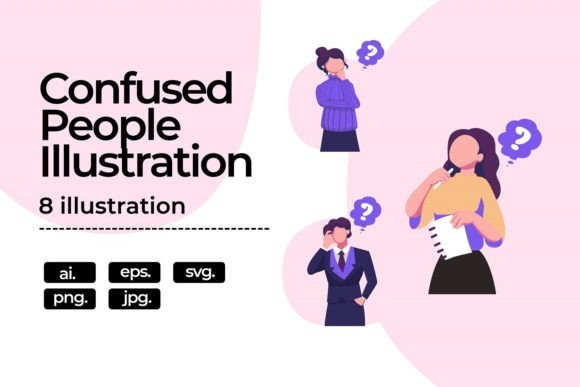
The visual language of confusion is surprisingly common. In websites, presentations, infographics, and marketing materials, designers frequently need to depict hesitation, misunderstanding, or uncertainty. Finding high-quality, consistent illustrations to represent these states can be a challenge. This is where a dedicated resource like the People Confused Flat Illustration pack becomes a practical asset. This collection provides eight distinct illustrations of people in various poses of confusion, rendered in a clean, modern flat style.
What Makes This Illustration Set Distinctive
Unlike sourcing individual images from disparate stock sites, this pack offers a cohesive system. Each illustration shares the same core artistic approach: simplified forms, minimal detail, and a focus on gesture and posture to convey emotion. This consistency is its primary strength. When used across a project—say, a series of blog posts explaining complex topics or a step-by-step troubleshooting guide—the repeated visual theme creates a professional, unified look. The confusion is communicated not through exaggerated, cartoonish expressions, but through thoughtful body language, such as a person scratching their head, looking at a document with a puzzled frown, or gesturing with palms open in a question.
Practical Value and Format Flexibility
The practical utility is significantly enhanced by the included file formats. Receiving EPS, AI, SVG, PNG, and JPG files means the asset is adaptable to nearly any design workflow. The vector formats (EPS, AI, SVG) are essential for professionals. They allow for infinite scaling without loss of quality, perfect for large-format prints or responsive web design where an icon might need to appear at various sizes. The editable color, based on an RGB foundation but convertible to CMYK, is another key feature. This enables designers to match the illustrations exactly to their brand palette or project theme, ensuring the assets integrate seamlessly rather than clash.
The PNG and JPG raster files provide quick-use options for situations where immediate placement is needed, such as in a rapid PowerPoint deck or a web article. Having all these formats in one package removes the friction of conversion, saving valuable time for freelancers and in-house teams working under deadlines.
Analyzing Real-World Application and Performance
In application, these illustrations perform a specific function: they visually annotate content that deals with problems, FAQs, or complex information. For example, an educator creating a tutorial on a tricky software feature might use one of these illustrations to highlight a common point of user difficulty. A marketer crafting an email campaign about a common customer misconception could employ an image to draw attention to the section addressing it. The flat style itself is advantageous; it is contemporary, avoids visual clutter, and tends to load quickly on websites, contributing to better user experience and site performance.
The quality of such a pack hinges on the clarity of the artwork and the range of expressions. Eight illustrations provide a reasonable variety, covering different genders and poses, which should suffice for most projects requiring this specific emotion. It avoids being overly repetitive. However, its utility is inherently niche. It is not a general-purpose human figure pack. Its long-term value is tied directly to how often a creator needs to depict confusion or uncertainty. For someone producing regular content in tech support, academic instruction, or complex service explanation, this set could become a reliable, go-to resource in their library.
Who Benefits Most from This Asset
The audience for this product is specialized but broad within the creative and professional sphere. User experience (UX) designers and web designers can use these illustrations in error state pages, help sections, or onboarding flows. Content marketers and bloggers focusing on explanatory or problem-solving articles can use them to break up text and visually reinforce their message. Corporate trainers and educators developing instructional materials will find them useful for highlighting challenging concepts. Small business owners creating their own infographics to explain their services or address common client questions can utilize these assets to achieve a polished look without custom illustration budget.
For serious hobbyists running detailed tutorial blogs or channels, it offers an upgrade from generic stock imagery. The key is that the beneficiary is someone who recognizes the communicative power of a consistent visual motif and has a recurring need for this particular emotional cue.
Professional Considerations and Workflow Integration
Integrating a resource like the People Confused Flat Illustration pack into a professional workflow is straightforward. The vector files allow for deep customization if needed; limbs or elements could be rearranged, colors changed in batches, or items added to the scene using the same software. This flexibility supports brand consistency across platforms.
A possible limitation to consider is style match. The flat illustration style is popular, but it must align with the existing visual identity of the project or brand. If a company’s materials use photorealistic images or a very different artistic style, these illustrations might not integrate smoothly without additional design work to harmonize them. Furthermore, while eight poses are useful, a project requiring a very wide array of specific confused scenarios—confusion about a map versus confusion about a financial chart—might find the set somewhat limited, though the editable nature allows for some contextual adaptation.
When evaluating fit, one should ask: Does my project or ongoing work require visually representing doubt, questions, or learning difficulties? Would a set of consistent, professional illustrations for this purpose save me time and improve visual coherence? If the answer is yes, then this collection represents a focused solution. It is not a flashy, all-purpose toolkit, but a specialized instrument for a specific communicative task. For those who need that task performed regularly, it offers reliability, quality, and efficiency, which are the hallmarks of a valuable professional asset.