Unlocking Your Family History: The Power of Printable Genealogy Tree Templates
Exploring your family lineage is a journey into personal history, identity, and connection. Yet, for many, the process of mapping out generations can feel daunting, requiring meticulous research and clear organization. This is where the practical magic of a Family Tree Template Genealogical Tree and a Family Tree Template Genealogical Tree Printable Worksheet comes into play. These tools are not mere diagrams; they are structured guides designed to simplify storytelling, making the discovery of your ancestry an accessible, engaging project for anyone, from schoolchildren to adults at family reunions.
What Are Family Genealogy Tree Templates?
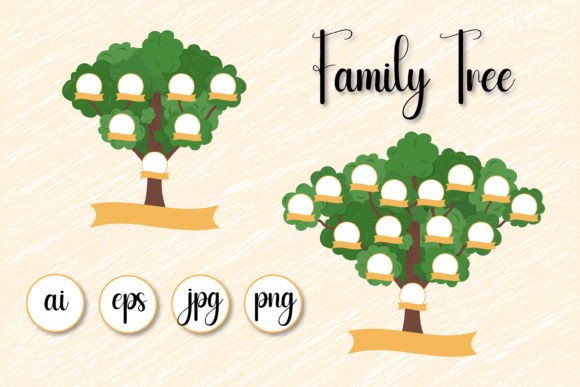
At their core, these templates are visual frameworks—often presented as classic infographics—that illustrate the relationships between family members across generations. A typical set, like the one described, offers two primary design options, each serving a slightly different purpose. The first is a traditional tree illustration with spaces for three to four generations, immediately showing the hierarchical relationship from a child up to grandparents. The second design provides intentionally blank spaces, acting as a worksheet where you can fill in names, dates, or even attach photographs of specific relatives: the child, mother, father, grandmothers, grandfathers, and great-grandparents.
These resources are provided in multiple, versatile file formats to suit various needs and technical skills. A ZIP folder typically contains:
- AI and EPS files: These are vector, editable formats for professional designers or those who wish to customize the template extensively using software like Adobe Illustrator, CorelDRAW, or Affinity Designer.
- JPG files: High-resolution images with a white background, perfect for simple printing or digital insertion into documents.
- PNG files: High-resolution images with a transparent background, offering flexibility for overlaying on other materials or creating digital presentations.
The US Letter aspect ratio ensures the templates are optimized for standard home and office printing, removing a common technical hurdle.
The Purpose and Significance of Visualizing Your Lineage
Why does a simple chart hold such significance? A family tree transforms abstract names and dates into a tangible map of belonging. Its purpose is twofold: documentation and connection.
From a practical standpoint, it serves as a central record, organizing vital information that might otherwise be scattered across old letters, disparate online profiles, or fading memories. For genealogical research, this organization is the first critical step. More profoundly, however, creating a family tree fosters connection. It can spark conversations between generations, unveil shared heritage across distant branches of a family, and provide younger members with a concrete sense of their place within a larger, ongoing story. In an era where families are often geographically dispersed, a completed tree becomes a shared artifact of identity, perfect for bringing to a reunion or sharing digitally.
Practical Relevance in Modern Life
These templates fit seamlessly into various aspects of contemporary life. In education, they are a staple for school projects, teaching children not only about their own history but also about social structures, historical timelines, and basic research skills. For personal enrichment, they offer a creative hobby that combines historical investigation with the artistic satisfaction of creating a beautiful, personalized document. In the context of technology, while many digital apps exist for genealogy, a printable worksheet offers a tactile, offline activity that can be a refreshing contrast to screen-based work. It can also serve as the foundational draft that later gets digitized.
A common misunderstanding is that genealogy is exclusively for historians or those with vast, well-recorded families. These templates challenge that assumption by providing a starter framework. You don't need to know ten generations back to begin; you start with what you know—yourself, your parents, your grandparents—and the template visually guides you on where to look next. It makes the process iterative and manageable.
Exploring the Two Design Options: A Closer Look
Understanding the specific utility of each template option helps you choose the right tool for your project phase.
The Pre-Illustrated Traditional Tree
This option, showing a child, parents, and grandparents, is ideal for quick reference and introductory projects. Its value lies in its immediacy. For a child's school assignment or a simple display at a reunion, this tree clearly communicates the basic concept of generational lineage without requiring any filling in of structural relationships. It’s a complete infographic that says, “This is how a standard family tree looks.” It helps beginners understand the schema before they attempt to build their own customized version.
The Blank Worksheet Template
This is the active, participatory tool. The blank spaces for each family member role are invitations for information. This design is profoundly flexible:
- You can write in names and birthdates.
- You can glue or digitally place small photographs, making it a pictorial family history.
- It accommodates different family structures; you can use multiple spaces for “mother” and “father” if needed, or leave some blank if information is unknown.
- The inclusion of spaces for great-grandparents encourages the researcher to extend their inquiry one generation further, naturally expanding the historical scope.
This worksheet is where research becomes personal creation. The act of filling it in is the journey itself.
The Advantage of Multi-Format Digital Files
The provision of the templates in AI, EPS, JPG, and PNG formats speaks directly to modern, varied use cases. The vector files (AI, EPS) are essential for customization. Perhaps you want to change the color scheme to match a reunion theme, add a decorative border, or translate the text labels into another language. Vector editing allows this without loss of quality. The high-resolution JPG and PNG files are the ready-to-use solutions. The JPG with a white background is perfect for straightforward printing, while the PNG with transparency can be layered onto a digital scrapbook, a website, or a custom background for a framed display. The high resolution of 300 dpi ensures that even printed versions are crisp and professional, suitable for display.
How to Use Your Template: A Step-by-Step Guide
Begin with the blank worksheet. Start with the information you know with absolute certainty—typically yourself and your parents. Fill in those spaces. Then, reach out to living relatives, consult family documents (like bibles, old passports, or certificates), or use online archives to populate the grandparent spaces. The great-grandparent spaces might require deeper research, but they provide a clear goal.
As you gather data, you might choose to create a working copy on the printable JPG and a final, artistic version using the editable vector files. For a school project, a child might color in the printed tree and add photos. For a family reunion, you might use the vector files to create a large, poster-sized version from a professional printer, serving as a centerpiece for the event.
Remember, the tree is not just a fact sheet; it’s a storytelling device. Consider adding brief notes next to names—“immigrated in 1910,” “master carpenter,” “told the best stories”—to bring the chart to life.
Common Pitfalls and How the Template Helps Avoid Them
New genealogists often make assumptions that can derail their project. One is assuming completeness is required. The template, by its structured spaces, shows that it’s okay to have blanks; the project is about progress, not perfection. Another is getting overwhelmed by disorganized data. The template provides immediate organization, forcing you to categorize information by generation and role, which clarifies further research paths. Finally, some may underestimate the visual impact. A hand-filled worksheet can feel informal, but using the high-resolution files to create a clean, printed final product underscores the importance and beauty of the family history you’ve compiled.
Building a Broader Understanding of Genealogy
Using a printable family tree template is often the first step into the wider world of genealogical study. This simple act of mapping can ignite curiosity about historical context, genetics, surname origins, and migration patterns. The template provides the skeletal framework; the stories and historical details you uncover become the flesh and blood. It demonstrates that genealogy is both a science (requiring research and verification) and an art (requiring presentation and narrative). In daily life, this broader understanding fosters a sense of historical continuity and personal resilience, linking individual identity to the collective human experience.
Conclusion: Your Story, Beautifully Captured
A Family Tree Template Genealogical Tree Printable Worksheet is more than just a set of illustrations. It is a gateway tool, a project planner, and a creative canvas. By offering structured designs in versatile, high-quality formats, it removes technical barriers and focuses your energy on the meaningful work of discovery and connection. Whether for a classroom, a living room, or a reunion hall, it helps capture and share your family’s history not just accurately, but beautifully, ensuring that the legacy of those who came before is visualized, honored, and passed forward with clarity and pride.
For those embarking on this rewarding journey, such templates provide the perfect starting point. And as your research grows, you can explore other designs and resources available in stores to support ever more detailed and expansive family history projects.