Evaluating a Professional Nursing Flyer Template for Health Care Communications
In the competitive world of health care marketing and professional development, clear and visually appealing communication is crucial. For nurses, medical facilities, and educational institutions, promotional materials need to convey trust, competence, and modernity. Your Nursing Horizontal Flyer presents itself as a specialized template designed to meet these needs. At its core, it is a pre-designed graphic layout tailored for creating nursing-related print and digital materials, such as flyers, posters, or event announcements.
What Distinguishes This Nursing Flyer Template
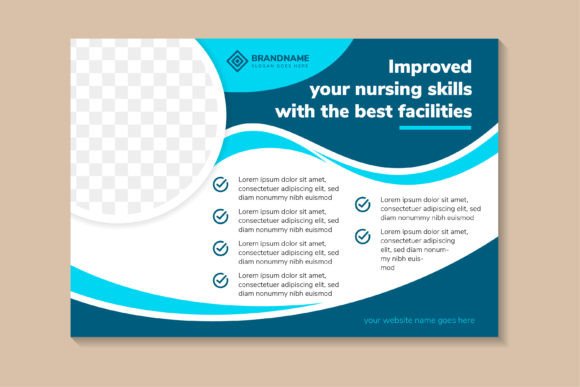
Many generic business templates exist, but a template focused specifically on nursing and medical themes offers distinct advantages. The Your Nursing Horizontal Flyer is built around a horizontal A4 layout, a common standard for flyers and handouts. Its design incorporates multicolor blue elements—a color palette strongly associated with professionalism, cleanliness, and health care. This deliberate choice can immediately signal the document’s context to the viewer.
The technical specifications are noteworthy for users with specific quality requirements. Being offered in high resolution (300dpi) ensures that prints will be sharp and clear, a critical factor for materials displayed in clinics or at conferences. The claim that all graphics are 100% vector is significant for editors; vector graphics can be resized infinitely without losing quality, allowing the template to be adapted for a banner or a smaller leaflet without pixelation. The inclusion of editable text, shapes, and color within the provided file formats (AI, EPS, SVG, JPG) means the template is not a static image but a flexible starting point for customization.
Comparing Template Approaches for Medical Professionals
When considering how to create a nursing flyer, one typically evaluates several paths: hiring a designer, using a basic word processor, subscribing to an online template service, or purchasing a standalone template like Your Nursing Horizontal Flyer. Each approach involves different tradeoffs in cost, time, control, and final quality.
Hiring a designer offers maximum customization but is often the most costly and requires clear communication of your vision. Using a word processor is low-cost and familiar but usually results in a more basic, less polished design that may not compete visually with professional materials. Online template services provide vast libraries and often include drag-and-drop editors, but their templates can sometimes feel generic, and ongoing subscriptions are required.
A purchased standalone template, such as this one, sits between these options. It provides a professionally crafted foundation with a specific aesthetic—the nursing-focused icons, color coding, and organized layout—at a fixed one-time cost. The user gains significant control via editable files but must possess, or have access to, vector graphic software (like Adobe Illustrator for the .AI file) to make the most profound changes. This requirement is a key decision factor.
Strengths and Potential Limitations
The strengths of Your Nursing Horizontal Flyer are its specialization and technical quality. The pre-organized space for photos, text, and graphics means a user isn’t designing from a blank page. Elements related to care, equipment, and science are integrated, potentially reducing the time spent sourcing appropriate icons. The well-organized layer structure in the vector files, if properly maintained by the creator, is a major benefit for efficient editing.
Potential limitations revolve around flexibility and software dependency. While colors and text are editable, the overall layout and style are fixed. If your project requires a radically different look—a minimalist monochrome design or a highly playful brochure—this specific multicolor blue template might not be the best starting point, even with editing. Furthermore, the ability to fully utilize the .AI or .EPS files depends on having compatible professional software. The included .JPG is a flat image, useful for reference or very simple edits in basic programs, but it doesn’t offer the editable vector benefits.
Identifying the Best-Fit Situations for Use
This template is likely an excellent fit for several realistic scenarios. Consider a nursing school department needing to promote an open day or a new continuing education course. They have the content—dates, photos of facilities, program details—but lack in-house design expertise. Your Nursing Horizontal Flyer gives them a credible framework to assemble that content quickly.
Similarly, a private clinic launching a new service or welcoming a new nurse practitioner might use it to create a community handout. The pre-established medical aesthetic lends an air of authority. Another ideal use case is for individual nurses creating a professional conference poster or a visual resume to highlight their skills and career path in a clean, graphic format.
The template’s horizontal layout makes it suitable for event flyers, program overviews, and informational posters that are meant to be read at a glance. Its design leans corporate and clean, which aligns well with formal institutional communications.
When Another Option Might Be Necessary
It’s equally important to recognize situations where this specific template may not be the right choice. If the communication requires a vertical (portrait) orientation—common for some brochures or magazine inserts—the horizontal constraint is a problem. Projects demanding a fully custom illustration style or a brand color scheme that clashes with the blue multicolor theme would require extensive redesign, perhaps making a blank-slate project more efficient.
For users without access to vector editing software, the value proposition diminishes. They would be working primarily with the .JPG version, which offers limited editability. In such cases, an online template service with a web-based editor, or even a well-formatted Word template designed for medical purposes, could be a more practical alternative despite potentially lower graphic quality.
Key Decision Factors for Selecting a Flyer Template
Making an informed choice involves weighing a few concrete factors:
- Software Access: Do you or your team have Adobe Illustrator, CorelDRAW, or another program that can open and edit .AI/.EPS/.SVG files? If not, can you work effectively with the provided .JPG?
- Design Alignment: Does the template’s style—its color palette, icon set, and overall “feel”—match the tone of your organization and the specific message? Does it look like something your target audience would expect from a nursing or medical entity?
- Project Scope: Is this a one-time need, or will you produce many variations over time? A one-time purchase can be cost-effective for a single project, whereas recurring needs might justify different tools.
- Time vs. Quality Balance: How quickly do you need the final product, and what level of polish is required? This template can accelerate the process compared to a from-scratch design while maintaining a professional output.
Ultimately, Your Nursing Horizontal Flyer is a resource that blends specificity with flexibility. It is not a one-size-fits-all solution for every graphic design need in health care, but for projects that align with its format and aesthetic, it can significantly streamline the creation of credible, high-quality visual communications. By understanding its distinct features, the tradeoffs against other methods, and the situations where it fits best, nursing professionals and administrators can make a more confident decision about whether it meets their particular needs.